
If you have ever attempted to keep up a yard in the Charlotte metro area, you are already aware of the biggest landscaping secret in the region: behind that thin covering of green grass is a thick, uncompromising layer of heavy Piedmont red clay. Despite the fact that this well-known clay is rich in nutrients, its physical form makes it quite challenging for homeowners to obtain a lush, carpet-like lawn.
During our intense summers in North Carolina, unmanaged clay bakes into a brick-like mass. It turns into a thick, wet sponge that traps water on the top and suffocates the roots beneath due to heavy rainfall in the winter and spring. If your lawn seems uneven, thins out despite frequent watering, or has frequent weed invasions, soil compaction is more likely to be the issue than fertilizer or seed.
Fortunately, a subpar yard is not something you have to put up with. Combining mechanical core aeration with organic compost topdressing may completely alter the structure of your soil from the ground up.
Table of Contents
What Is Soil Compaction and Why Does Clay Make It Worse?
Understanding the structure of clay will help you understand why your grass might be having trouble. Clay particles are extremely tiny, flat, and densely packed at the microscopic level. Clay particles readily compress under even the smallest pressure, in contrast to sandy soil, which contains big, irregular particles that provide lots of room for water and air to flow freely.
When these particles are compressed together, the crucial “macro-pores” in the soil are eliminated, resulting in soil compaction. Compaction in Charlotte gardens is frequently caused by the following:
- Foot traffic includes children playing, dogs running along fences, and the weight of a typical lawnmower.
- Weather extremes include intense summer heat that bakes exposed soil and torrential downpours from thunderstorms that pound the soil’s surface.
- Construction Residuals: Homes are situated directly on compacted subsurface clay in many local developments that are constructed on graded plots where the rich topsoil was scraped away.
Compacted dirt functions as a physical barrier. As much as they need water, the grass roots also need oxygen. Compacted clay deprives roots of oxygen, prevents them from penetrating deeply into the ground, and prevents them from absorbing nutrients. Additionally, the inability of water to seep into the ground causes runoff, pooling, and a shallow root system that quickly withers away during a typical July dry spell.
The Solution: Mechanical Core Aeration
The first and most crucial step in breaking this compaction cycle is mechanical core aeration.
Many homeowners confuse “spike aeration” (using a pull-behind spike aerator or spiked shoes) with actual aeration. Because they force the clay sideways and downward to create a hole, spikes actually improve compaction in heavy clay.
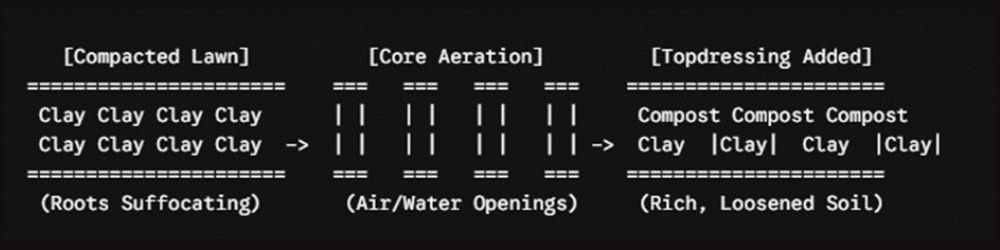
A commercial-grade device with hollow tines is used for true core aeration. It physically extracts cylindrical plugs (or cores) of dirt from the ground as it travels around your yard. These plugs are usually 2 to 3 inches deep and roughly half an inch broad, and they are then deposited on the surface.
What Happens Once the Cores Are Pulled?
- Instant Relief: As soon as the plugs are physically removed, the soil’s lateral pressure is released, allowing the remaining clay to expand and relax.
- Direct Nutrient Access: The perforations open up pathways that lead directly to the root zone. The solid surface crust may now be entirely circumvented by fertilizer, water, and oxygen.
- Root Expansion: Naturally, grass roots spread out into these exposed areas, becoming thicker and deeper than previously.
Timing Is Everything in Charlotte
The sort of grass you have completely determines when to aerate it. Due to Charlotte’s location in the agricultural “Transition Zone,” both cool-season and warm-season grasses can be found on local lawns:
- Tall Fescue (Cool-Season): Should be aerated in the early autumn (September to October). This aligns perfectly with the optimal time to overseed Fescue, allowing the new seeds to fall directly into the aeration holes for maximum soil-to-seed contact.
- Bermuda and Zoysia (Warm-Season): Should be aerated in the late spring to early summer (late May through June) when the grass is actively growing and can rapidly recover and fill in.
The Secret Weapon: Compost Topdressing
While core aeration provides immediate physical comfort, treating clay over an extended period of time requires changing its chemical and structural composition. In this case, topdressing is helpful.
Topdressing is the process of applying a thin, fine coating (about 1/4 to 1/2 inch) of rich, organic compost to your whole lawn immediately following core aeration.
Why the mix is important: If you topdress a lawn without first aerating it, the compost just sits on top of the hard clay crust. But when you topdress immediately after core aeration, the nutrient-rich compost falls directly into the freshly made holes.
Over the following several weeks, the compost combines with the clay, enriching the underlying soil with organic matter and millions of beneficial bacteria. The strong bonds between the clay particles are broken by these microbes. This method transforms a hard, compact clay bed into a rich, loamy, well-draining lawn that retains precipitation without submerging the turf, permanently altering the structure of your soil over time.
Why DIY Aeration Fails on Heavy Clay
It can be tempting to rent an aerator from a big-box home improvement store over the weekend, but DIY attempts on Charlotte clay frequently yield disappointing results for several reasons:
- Inadequate Equipment Weight: Standard rental aerators are occasionally too light to puncture cemented red clay. They frequently bounce around the surface, removing shallow, useless ½-inch plugs instead of the deep cores required to produce a structural change.
- Inadequate Soil Moisture Calibration: Aeration on clay requires ideal soil moisture. If the ground is too dry, the tines cannot puncture it. If the clay becomes too moist, it turns into mud, which clogs the tines and prevents your grass from leveling. Before beginning, expert teams are skilled in evaluating and preparing a yard.
- Effort-Intensive Topdressing: Spreading compost evenly across a yard at a precise depth without strangling your existing grass requires specialized equipment and a significant amount of personal labor. If sprayed excessively, it can harm the turf by obstructing sunlight.
Invest in the Long-Term Health of Your Yard
In fact, beautiful lawns are built from the ground up. Your efforts will be in vain if the roots are trapped in a vice grip of compacted red clay, even if you spend hours watering your grass and apply the most expensive fertilizers.
Investing in a professional core aeration and organic topdressing regimen is the only way to get over the clay barrier, boost drought resilience, and achieve the bright, healthy lawn your Charlotte, NC property deserves.
Ready to transform your Charlotte soil? Contact the local turf experts at Top Gardens today to schedule a comprehensive soil assessment and secure your spot for seasonal aeration and topdressing.
Since 1999, Top Gardens have completed numerous landscape designs and installation projects in Charlotte, NC and built lasting relationships with our clients providing exemplary garden maintenance service. Whether you need reliable mowing and edging, effective yard drainage, a hardscape feature, retaining walls, landscape lighting, or freshly mulched beds—or you’re envisioning a complete transformation of your front and backyard—our team of expert Charlotte landscapers is ready to deliver exceptional results.